.png)
AI Metrics to Track:
4 New GEO KPIs to Replace Outdated SEO Metrics
From Static Banners to Smart Conversations: Why ChatGPT’s Ad Test is a Win for Semiconductor Marketing
AI Metrics to Track:
4 New GEO KPIs to Replace Outdated SEO Metrics
Life as an “SEO expert” has never been more difficult.
It seems like a lifetime ago when we could confidently answer what drives traffic to websites. And after years of struggle with SEO, just as we had cracked the code on search engines, LLMs flipped the script completely.
I’ve scoured Reddit and LinkedIn for AI optimization tactics, yet the data-driven certainty we marketers crave is still missing.
How do you prove that your content strategies are influencing the LLM responses? How do you measure success with AI results when every response is different?
While a lot has been written about how to optimize your content for GEO, not much has been written about how you measure if your strategies are truly working.
Why Is It So Difficult to Measure Success with GEO?
Traditional SEO is deterministic. To simplify, imagine a vending machine. You insert a coin, press “C4”, and the machine executes a code to drop a bag of chips. It’s repeatable. The outcome is the same every time.
LLM models are rather probability engines. Imagine a kid building a Castle with Lego bricks. There are hundreds of different bricks and no specific rule or order to follow. The kid looks at whatever they have built so far and ponders what’s the next brick that best fits the puzzle. The castle structure can be different every time.
AI is probabilistic, instead of fetching data from an index or a database, it generates the most likely sequence of tokens from its training data by looking for statistical patterns.
The shift from "fetching" to "generating" creates four massive headaches for us B2B marketers:
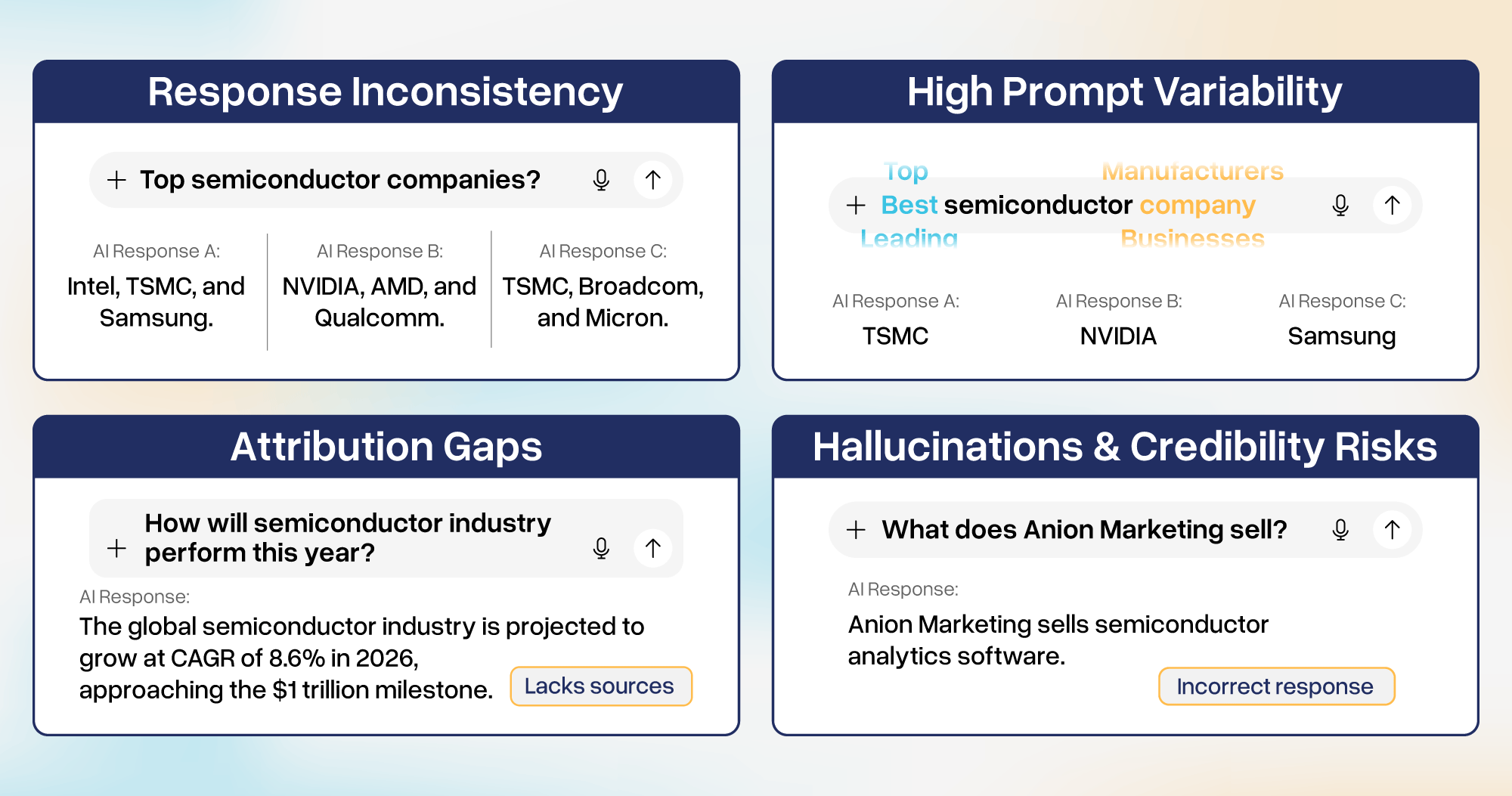
Response Inconsistency:
Hallucinations and Credibility Risks:
While traditional search engines might link to pages with errors, they won’t invent a feature your product doesn’t have. Instead of just fetching a correct fact, LLMs are optimized to generate plausible, intent-aligned answers that please the user.
A common risk is that AI can provide a "confident wrong answer" using confidence as a proxy for truth, often leading to credibility risk for your business.
Which Metrics Should Be Tracked for AIO/GEO?
If you are looking for a list of KPIs to include in your GEO Dashboard, you are in the right place. In the old days, we had a handful of north star metrics: “Impressions, Clicks, CTR...”, but in the AI Era, the dashboard can end up looking like a fighter jet cockpit.
Here is your new GEO Metric glossary:
Measuring GEO can be like driving a car in a fog, especially when you have so many metrics to track. Let’s strip back all the noise and pick the top 4 metrics that would help you answer the most important questions regarding your AI strategy.
- AI Signal Rate: In the AI era, the measure of success has shifted from traffic to visibility. While we can’t measure absolute visibility, we can sample it with topic-specific prompts, repeated regularly, to assess presence percentage.
- AI Accuracy Rate: This crucial metric helps track the credibility of your brand in AI responses.
- AI Share of Model: Benchmarking your results against your competitors is a crucial part of GEO Strategy.
- AI Influenced Conversion Rate: At the end of the day, we are optimizing revenue. This metric connects the dots between a user’s chat on an LLM site to a lead in CRM.
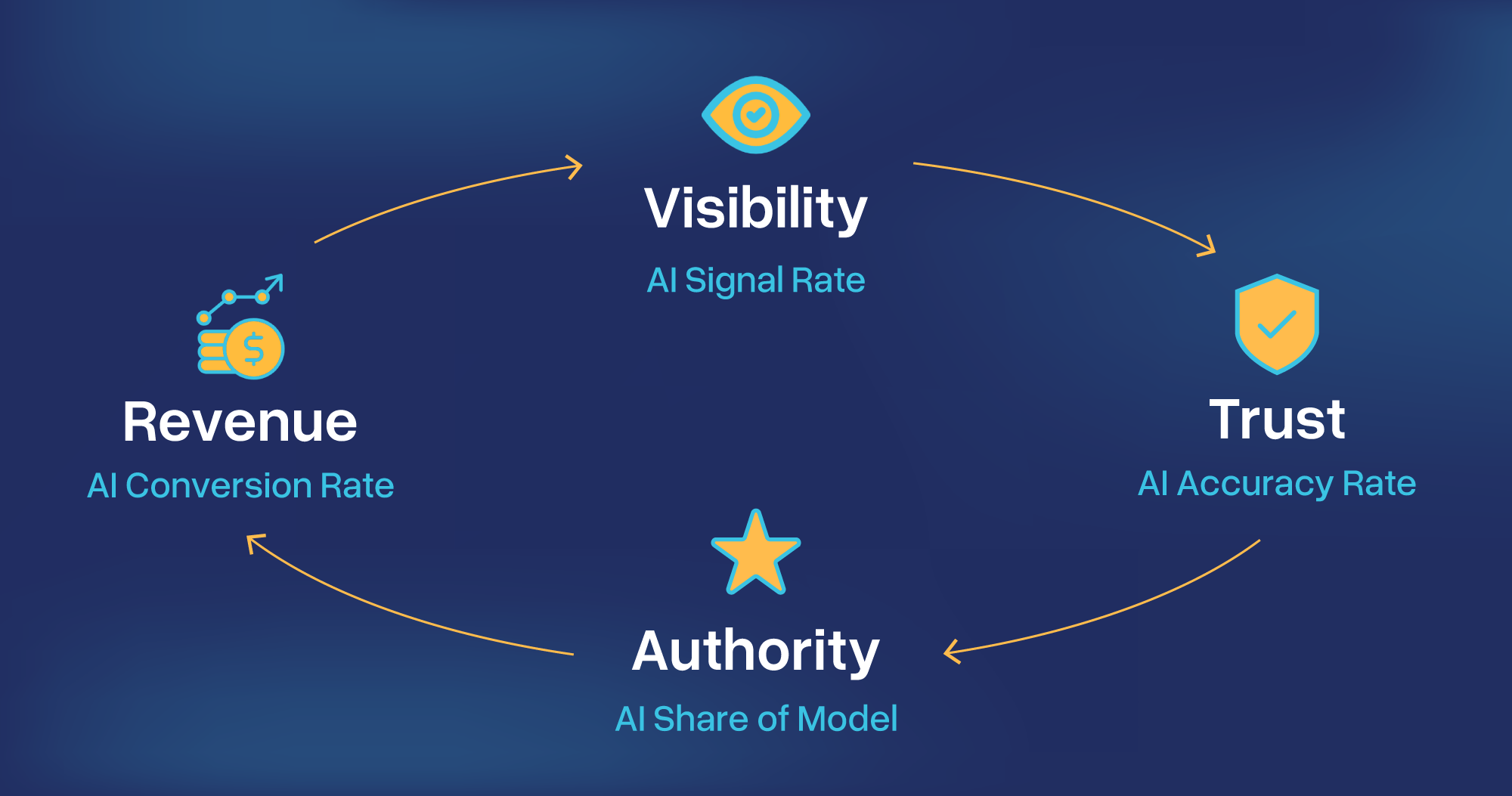
You can dive deeper into your own use case and figure out which metrics best suit your needs. These 4-core metrics, though, are holistic together and map the full funnel. The Signal Rate confirms your visibility, the Accuracy Rate ensures you are trusted, the Share of Model defines your market authority, and the Conversion Rate proves your strategy is working.
While understanding the metrics is the first step, building the right infrastructure to track them comes next. Tracking success in GEO requires a different set of tools than what we have used for decades.
AI is evolving rapidly, and at Anion Marketing, we don’t just monitor, we engineer your alignment with it. We help B2B semiconductor and tech companies develop GEO strategies, audit and architect technical content, and deploy the right stack of cutting-edge tools to track and convert AI responses to actionable insights.
Ready to upgrade your SEO to GEO? Contact Anion today!
About Author

Engineer turned storyteller turned marketer. Apart from running campaigns and demystifying MarTech, can talk for hours about science, tech, life, and movies - in that order.
Life as an “SEO expert” has never been more difficult.
It seems like a lifetime ago when we could confidently answer what drives traffic to websites. And after years of struggle with SEO, just as we had cracked the code on search engines, LLMs flipped the script completely.
I’ve scoured Reddit and LinkedIn for AI optimization tactics, yet the data-driven certainty we marketers crave is still missing.
How do you prove that your content strategies are influencing the LLM responses? How do you measure success with AI results when every response is different?
While a lot has been written about how to optimize your content for GEO, not much has been written about how you measure if your strategies are truly working.
Why Is It So Difficult to Measure Success with GEO?
Traditional SEO is deterministic. To simplify, imagine a vending machine. You insert a coin, press “C4”, and the machine executes a code to drop a bag of chips. It’s repeatable. The outcome is the same every time.
LLM models are rather probability engines. Imagine a kid building a Castle with Lego bricks. There are hundreds of different bricks and no specific rule or order to follow. The kid looks at whatever they have built so far and ponders what’s the next brick that best fits the puzzle. The castle structure can be different every time.
AI is probabilistic, instead of fetching data from an index or a database, it generates the most likely sequence of tokens from its training data by looking for statistical patterns.
The shift from "fetching" to "generating" creates four massive headaches for us B2B marketers:
Response Inconsistency:
Hallucinations and Credibility Risks:
While traditional search engines might link to pages with errors, they won’t invent a feature your product doesn’t have. Instead of just fetching a correct fact, LLMs are optimized to generate plausible, intent-aligned answers that please the user.
A common risk is that AI can provide a "confident wrong answer" using confidence as a proxy for truth, often leading to credibility risk for your business.
Which Metrics Should Be Tracked for AIO/GEO?
If you are looking for a list of KPIs to include in your GEO Dashboard, you are in the right place. In the old days, we had a handful of north star metrics: “Impressions, Clicks, CTR...”, but in the AI Era, the dashboard can end up looking like a fighter jet cockpit.
Here is your new GEO Metric glossary:
Our Recommendation: Which 4 Metrics to Pick for Navigating GEO?
Measuring GEO can be like driving a car in a fog, especially when you have so many metrics to track. Let’s strip back all the noise and pick the top 4 metrics that would help you answer the most important questions regarding your AI strategy.
- AI Signal Rate: In the AI era, the measure of success has shifted from traffic to visibility. While we can’t measure absolute visibility, we can sample it with topic-specific prompts, repeated regularly, to assess presence percentage.
- AI Accuracy Rate: This crucial metric helps track the credibility of your brand in AI responses.
- AI Share of Model: Benchmarking your results against your competitors is a crucial part of GEO Strategy.
- AI Influenced Conversion Rate: At the end of the day, we are optimizing revenue. This metric connects the dots between a user’s chat on an LLM site to a lead in CRM.
You can dive deeper into your own use case and figure out which metrics best suit your needs. These 4-core metrics, though, are holistic together and map the full funnel. The Signal Rate confirms your visibility, the Accuracy Rate ensures you are trusted, the Share of Model defines your market authority, and the Conversion Rate proves your strategy is working.
While understanding the metrics is the first step, building the right infrastructure to track them comes next. Tracking success in GEO requires a different set of tools than what we have used for decades.
AI is evolving rapidly, and at Anion Marketing, we don’t just monitor, we engineer your alignment with it. We help B2B semiconductor and tech companies develop GEO strategies, audit and architect technical content, and deploy the right stack of cutting-edge tools to track and convert AI responses to actionable insights.
Ready to upgrade your SEO to GEO? Contact Anion today!
Ready to upgrade your SEO to GEO? Contact Anion today!
About Author
Engineer turned storyteller turned marketer. Apart from running campaigns and demystifying MarTech, can talk for hours about science, tech, life, and movies - in that order.


.svg)

.png)