
Your Sales Data Is in Excel.
What If It Could Do More?
From Static Banners to Smart Conversations: Why ChatGPT’s Ad Test is a Win for Semiconductor Marketing
Email Marketing in 2026:
What the Data Says for B2B Technology Companies
A deal's total value does not always tell the full revenue story. When customer purchase volumes grow over several years, sales teams need to understand not just how much a deal is worth, but how that revenue is expected to develop year by year.
We explored this challenge in a HubSpot Sales Hub proof of concept (POC), looking at how custom properties, product line items, and reports could support multi-year revenue visibility.
The key takeaway: Build the data structure first, then build the dashboard. A useful forecast starts with how revenue is calculated, not how the numbers look on a screen.
The Question That Started It
Can we turn our Excel sheets into dashboards that actually help us understand future revenue?
This was something I had in mind when I started exploring HubSpot Sales Hub.
My background is in electronic engineering, and I work in marketing. I understand how marketing contributes to sales, but exploring B2B sales meant learning new concepts. Deal stages, pricing structures, customer requirements, and forecasting all have their own logic.
I wouldn't say I learned sales through HubSpot alone, but exploring the platform helped me understand how businesses manage sales information and how a CRM can support those processes.
Then a client came to us with a requirement that made this exploration practical. They wanted to forecast revenue over multiple years and see the numbers in dashboards instead of relying entirely on Excel sheets.
The interesting part was that this wasn't simply a request to display existing numbers in a chart. We needed to understand how the revenue projections should be stored in HubSpot before deciding how to report them.
That became the starting point of our proof of concept.
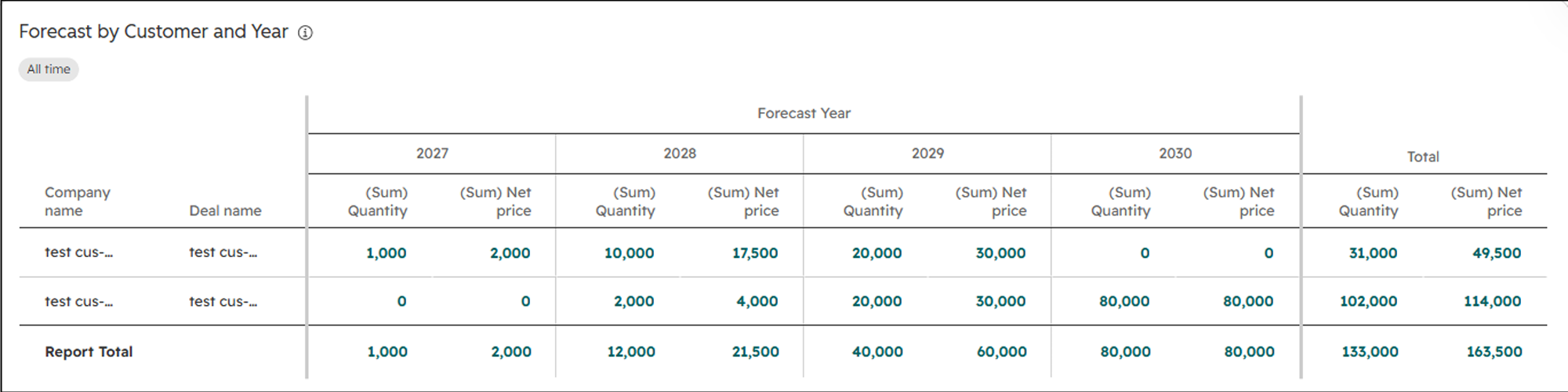
A Deal’s Value Doesn't Tell the Whole Story
A standard deal value is useful when you want to understand the potential value of an opportunity. But it doesn't always tell the full story when revenue develops over several years.
Recent research shows:
- 59% of B2B marketers consider email their top revenue channel
- 73% of B2B buyers prefer email for vendor communication
- 81% of B2B marketers say email newsletters are their most-used form of content distribution
- 79% of B2B companies say email is their most successful channel for reaching the right audience
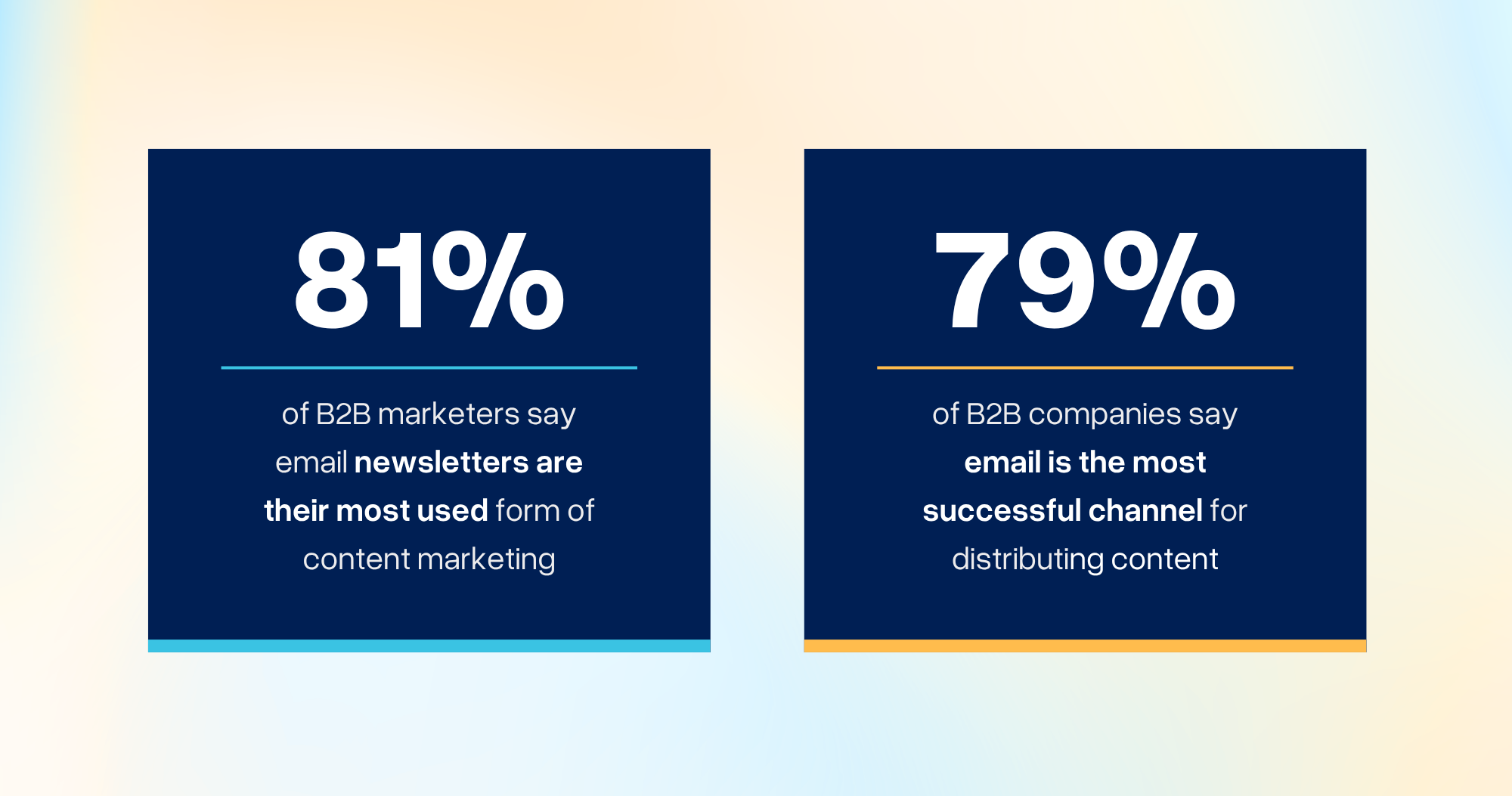
For semiconductor, electronics, and deep-tech companies, that makes sense. Engineers, procurement teams, and business stakeholders often need different information at different points. Email remains one of the easiest ways to deliver that information consistently.
Where Most Campaigns Fall Short
If email works so well, why do so many B2B campaigns underperform? Three issues stand out: misleading metrics, falling click engagement, and poor segmentation.
Open Rate Is No Longer Enough
Many teams still treat open rate as a key measure of success, even though it has become increasingly unreliable. Apple Mail Privacy Protection has inflated open rates by pre-loading email content on Apple devices, whether or not the recipient actually reads the message. A reported open no longer tells you much about attention, relevance, or intent.
That shift is already reflected in how marketers measure performance. According to Litmus:
- Only 17% of marketers now use open rate as their primary KPI
- 29% use click-through rate
- 24% use conversion rate
For B2B technology companies, better indicators include clicks, content downloads, replies, demo requests, and conversions.
Click Rates Are Falling
Recent email data shows a clear pattern: open rates have risen, while click rates have fallen, which usually points to a problem inside the email itself. The message may not be relevant enough, the CTA may be unclear, or the next step may ask for too much too soon.
CTA design matters. Emails with one focused call to action tend to perform better than emails with several competing options. In B2B technology, low-friction actions often work best, especially earlier in the buyer journey:
- View product details
- Download a datasheet
- Read an application note
- Register for a webinar
These actions match how technical buyers evaluate. A hard sales ask too early often reduces engagement.

Segmentation Is Still the Biggest Gap
This is where many B2B email programs lose the most value.
A power electronics engineer and a procurement manager should not receive the same newsletter with the same framing and CTA. Nor should a technical evaluator and a business lead.
Yet many companies still send one broad campaign to their full list. The result is predictable: some content feels partly relevant, but not relevant enough to drive action.
Most companies already have the data to improve this. Click patterns, downloads, topic preferences, and past engagement all show what subscribers care about. Platforms like HubSpot and Brevo support behavioural tagging and interest-based segmentation as standard features.
The issue is rarely data availability. It is how that data is being used.
How AI Makes Email More Effective
AI is now built into most email platforms. Tools like HubSpot and Brevo already offer subject line testing, send-time optimization, and behavior-based personalization. The gap is no longer access to these features. It is whether teams are using them well.
For B2B technology companies, AI is most useful when it improves segmentation and relevance. It can help teams use behavioural data to send different content to engineers, procurement contacts, and business stakeholders based on what they engage with. Most platforms already have that data. The gap is in using it consistently.
AI does not replace campaign thinking. Audience, message, timing, and goal still need to be defined first. Where AI helps is in execution: testing variations, automating follow-ups, and personalizing content at a scale that would be difficult to manage manually.
What Better Email Marketing Looks Like in 2026
Stronger email performance will come from more relevant campaigns, not more campaigns.
For B2B technology companies, that means:
- Segmenting by role, interest, and buying stage
- Matching content to what each audience actually needs
- Using one clear CTA per email
- Focusing on useful content, not generic promotion
- Measuring clicks, conversions, replies, and downloads instead of relying on opens
This brings email strategy back to the basics: clear structure, real authority, fresh information, and content that is genuinely useful.
Conclusion
Email remains one of the most effective marketing channels for B2B technology companies. The ROI is strong, buyer preference remains high, and the format still fits long, technical buying journeys.
But good results now depend on more than sending regular campaigns. They depend on relevance, segmentation, strong content, and metrics that reflect actual engagement.
For semiconductor, electronics, and other technology brands, that means building email programs around how buyers really evaluate and decide.
At Anion, we help semiconductor and deep tech companies build email programs that are more targeted, useful, and effective. That includes strategy, segmentation, newsletter planning, campaign execution, content development, lead nurturing, and performance analysis. We work with technical brands to build email programs that support awareness, strengthen engagement, and move the right audiences closer to action.
If your email campaigns are active but not delivering the engagement or pipeline they should, the issue may be in the strategy behind them.
About Author

Passionate about email marketing, automation, and turning data into campaigns that perform.

Email remains one of the highest-ROI marketing channels. Litmus reports an average return of $36 for every $1 spent, far ahead of pay-per-click and social media advertising.
For semiconductor companies, it is especially valuable because buying cycles are long, decisions involve multiple stakeholders, and technical information needs to be delivered clearly over time.
Yet many email programs still underperform. The most common reasons are straightforward: too much reliance on open rate, low click-through, and sending the same content to every contact on the list.
The 2025 data points to a clear conclusion. Email is still highly effective. But better results in 2026 will come from sharper segmentation, stronger content, clearer calls to action, and metrics that reflect real buyer intent.
Email Marketing Still Delivers Strong ROI
Litmus reports an average return of $36 for every $1 spent on email marketing. By comparison, pay-per-click advertising returns around $2 per $1 spent, while social media advertising returns about $1.75.

For B2B technology companies, this matters because email supports long, technical buying journeys. It gives companies a direct way to share product updates, application notes, datasheets, supplier announcements, whitepapers, and webinar invites without depending on platform algorithms.
Why B2B Buyers Still Prefer Email
Email’s value is not just in ROI. B2B buyers still prefer it for direct, relevant communication from vendors.
Recent research shows:
- 59% of B2B marketers consider email their top revenue channel
- 73% of B2B buyers prefer email for vendor communication
- 81% of B2B marketers say email newsletters are their most-used form of content distribution
- 79% of B2B companies say email is their most successful channel for reaching the right audience
For semiconductor, electronics, and deep-tech companies, that makes sense. Engineers, procurement teams, and business stakeholders often need different information at different points. Email remains one of the easiest ways to deliver that information consistently.
Where Most Campaigns Fall Short
If email works so well, why do so many B2B campaigns underperform? Three issues stand out: misleading metrics, falling click engagement, and poor segmentation.
Open Rate Is No Longer Enough
Open Rate Is No Longer Enough
Many teams still treat open rate as a key measure of success, even though it has become increasingly unreliable. Apple Mail Privacy Protection has inflated open rates by pre-loading email content on Apple devices, whether or not the recipient actually reads the message. A reported open no longer tells you much about attention, relevance, or intent.
That shift is already reflected in how marketers measure performance. According to Litmus:
- Only 17% of marketers now use open rate as their primary KPI
- 29% use click-through rate
- 24% use conversion rate
For B2B technology companies, better indicators include clicks, content downloads, replies, demo requests, and conversions.
Click Rates Are Falling
Click Rates Are Falling
Recent email data shows a clear pattern: open rates have risen, while click rates have fallen, which usually points to a problem inside the email itself. The message may not be relevant enough, the CTA may be unclear, or the next step may ask for too much too soon.
CTA design matters. Emails with one focused call to action tend to perform better than emails with several competing options. In B2B technology, low-friction actions often work best, especially earlier in the buyer journey:
- View product details
- Download a datasheet
- Read an application note
- Register for a webinar
These actions match how technical buyers evaluate. A hard sales ask too early often reduces engagement.
Segmentation Is Still the Biggest Gap
Segmentation Is Still the Biggest Gap
This is where many B2B email programs lose the most value.
A power electronics engineer and a procurement manager should not receive the same newsletter with the same framing and CTA. Nor should a technical evaluator and a business lead.
Yet many companies still send one broad campaign to their full list. The result is predictable: some content feels partly relevant, but not relevant enough to drive action.
Most companies already have the data to improve this. Click patterns, downloads, topic preferences, and past engagement all show what subscribers care about. Platforms like HubSpot and Brevo support behavioural tagging and interest-based segmentation as standard features.
The issue is rarely data availability. It is how that data is being used.
How AI Makes Email More Effective
AI is now built into most email platforms. Tools like HubSpot and Brevo already offer subject line testing, send-time optimization, and behavior-based personalization. The gap is no longer access to these features. It is whether teams are using them well.
For B2B technology companies, AI is most useful when it improves segmentation and relevance. It can help teams use behavioural data to send different content to engineers, procurement contacts, and business stakeholders based on what they engage with. Most platforms already have that data. The gap is in using it consistently.
AI does not replace campaign thinking. Audience, message, timing, and goal still need to be defined first. Where AI helps is in execution: testing variations, automating follow-ups, and personalizing content at a scale that would be difficult to manage manually.
What Better Email Marketing Looks Like in 2026
Stronger email performance will come from more relevant campaigns, not more campaigns.
For B2B technology companies, that means:
- Segmenting by role, interest, and buying stage
- Matching content to what each audience actually needs
- Using one clear CTA per email
- Focusing on useful content, not generic promotion
- Measuring clicks, conversions, replies, and downloads instead of relying on opens
This brings email strategy back to the basics: clear structure, real authority, fresh information, and content that is genuinely useful.
Conclusion
Email remains one of the most effective marketing channels for B2B technology companies. The ROI is strong, buyer preference remains high, and the format still fits long, technical buying journeys.
But good results now depend on more than sending regular campaigns. They depend on relevance, segmentation, strong content, and metrics that reflect actual engagement.
For semiconductor, electronics, and other technology brands, that means building email programs around how buyers really evaluate and decide.
At Anion, we help semiconductor and deep tech companies build email programs that are more targeted, useful, and effective. That includes strategy, segmentation, newsletter planning, campaign execution, content development, lead nurturing, and performance analysis. We work with technical brands to build email programs that support awareness, strengthen engagement, and move the right audiences closer to action.
If your email campaigns are active but not delivering the engagement or pipeline they should, the issue may be in the strategy behind them.
If you spend any time browsing LinkedIn, you probably come across 5-6 posts daily about AIO/GEO. At least one of them will have the term "Knowledge Cutoff" being thrown around like a looming expiration date for your content. The fear is that if an AI model finished its training in 2025, any content you’ve published since then is invisible to it.
The truth is, it’s complicated and a lot more interesting. One of the sharpest voices in this conversation, Wil Reynolds, recently posted on LinkedIn:
"...Gemini 3 Launched November 2025, the training data cutoff for Gemini 3 is believed to be January 2025. That means for answers that come from training data, all the work you've done since February 2025 is having no impact on 'training data' answers."
That's a bold statement. We wanted to test it ourselves.
If an LLM's knowledge is frozen at a specific date, what happens to all the content you published after that date? Does your latest blog post, your updated product page, simply... not exist for the model?
On the surface, yes. But modern LLMs don't rely solely on training data anymore. And that changes everything.
What Does Knowledge Cutoff Mean?
Training a frontier model like GPT-5 or Gemini 3 is super expensive and takes months of computing power. You can't just "hit save" and expect it to instantly know what happened five minutes ago. The data must be cleaned, deduplicated, and processed. The training data cutoff is the literal date after which no new data was included when training the model. By the time a model is released to the public, the world has already moved on. Knowledge cutoff is the point up to which the model can reliably answer questions from its training data.
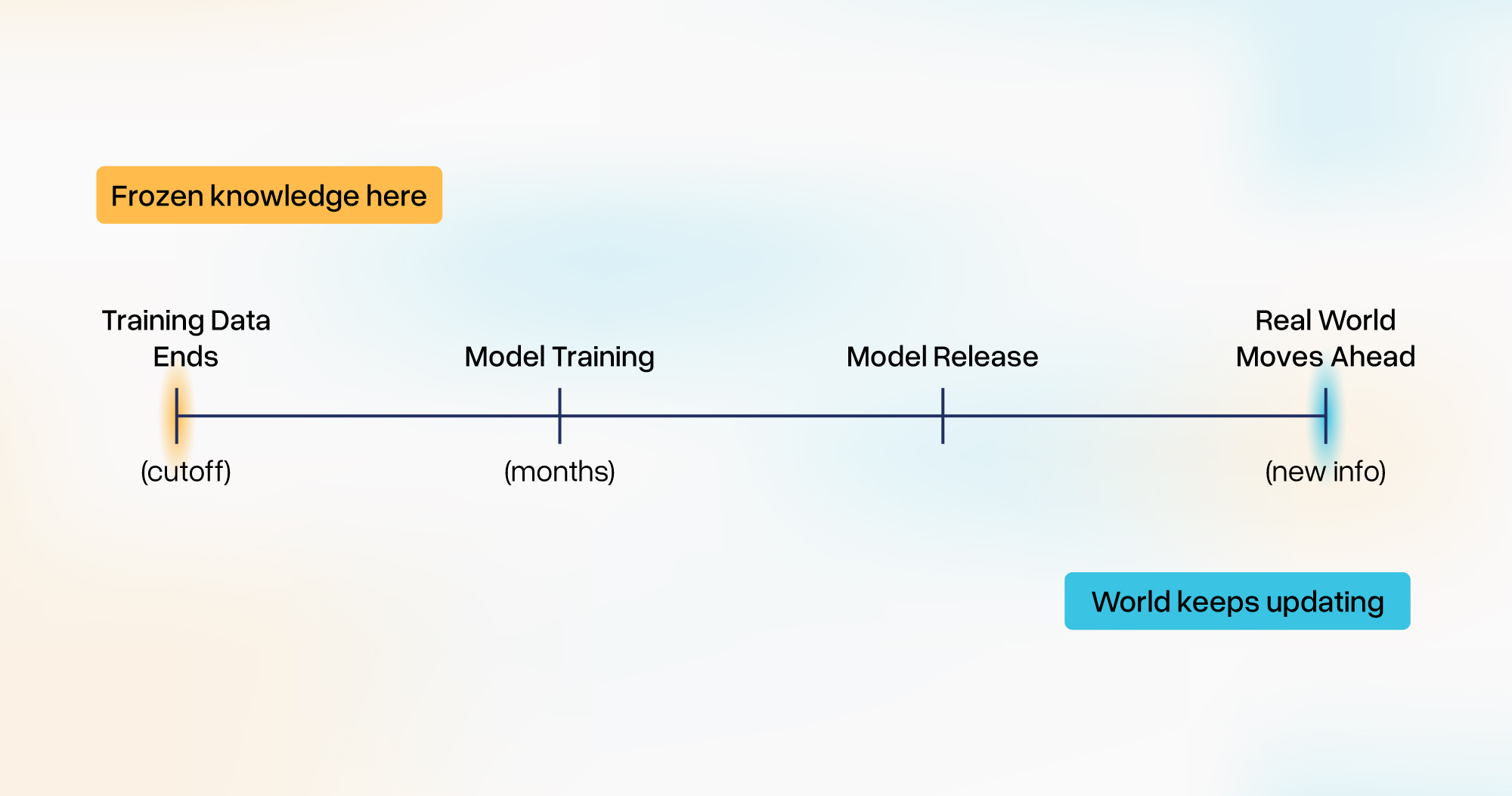
What Are The Knowledge Cutoff Dates For Different Models?
Here is the landscape as of early 2026:
Do Knowledge Cutoffs Really Matter? How Do They Impact Results?
Here's the thing. Every major LLM provider knows that stale data is a problem. If an AI model was trained before your latest product launches, and it doesn't use a live search tool, it will confidently describe your old specs as the current standard. AI companies realized this problem soon and had a solution.
To understand how the knowledge cutoff doesn't always result in a "dead end," we need to talk about RAG (Retrieval-Augmented Generation).
RAG is the bridge between frozen training data and the live internet. Instead of relying only on what the model learned during training, RAG allows the LLM to fetch real-time information from external sources like search indexes, databases, APIs, and weave it into its response.
Imagine a brilliant professor locked in a library since the start of 2025. If you ask him about a 2026 event, he wouldn’t know the answer. That’s how standard LLMs with a knowledge cutoff behave.
RAG is like giving that professor a high-speed internet connection. When you ask about the 2026 event now, the professor will be able to Google it, understand its nitty-gritties, and explain the answer in detail.
This should, in theory, solve the cutoff issue entirely. But does it? We decided to run an experiment to see how much training data vs. real-time retrieval shapes the final answer.
The “Knowledge Cutoff” Experiment
We designed an experiment to test whether knowledge cutoffs actually impacted answers across LLMs. We asked AI to help us craft a prompt that should theoretically generate outdated responses based on each model's training data boundary.
We targeted a major tech industry milestone for this experiment, and here's the prompt we landed on:
"What's the largest single crystal SiC wafer diameter that has been demonstrated?"
The logic was simple. Before Gemini 3.1 and GPT-5.4's cutoff (Aug 2025), the semiconductor industry was firmly centered on the 200mm SiC wafers. But in January 2026, Wolfspeed announced that it had successfully demonstrated a single-crystal 300mm SiC wafer, a technology breakthrough. If knowledge cutoffs truly dictate responses, both Gemini 3 and GPT-5 should show the 200mm SiC wafer as the largest one demonstrated.
We submitted the prompt to both Gemini 3.1 and ChatGPT-5.4
The result? Both models returned similar responses. Both referenced Wolfspeed’s single-crystal 300mm SiC wafer. Both provided current and accurate answers for the prompt.
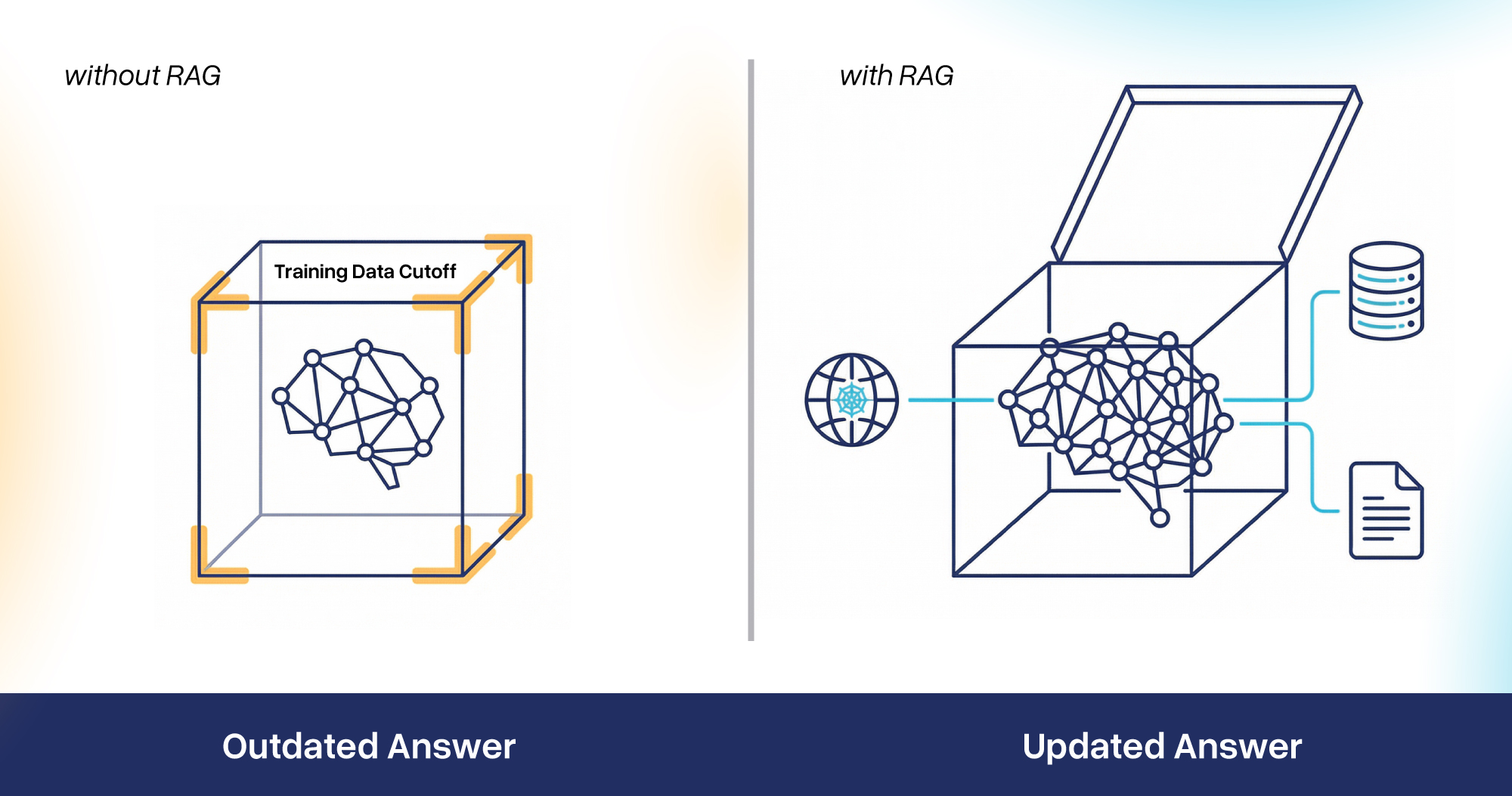
We repeated the experiment. Different accounts. Different sessions. Same outcome every time.
It confirmed that neither model was stuck in its training-data bubble. Both were pulling fresh information from the web and integrating it seamlessly into their answers. The knowledge cutoff, at least for this type of factual, fast-changing technical query, was essentially invisible to the end user.
This doesn't mean knowledge cutoffs are irrelevant. For nuanced opinions, contextual understanding, and deeply synthesized answers, training data still matters. But for factual, verifiable queries? RAG has largely neutralized the cutoff problem.
Does SEO Still Matter In the AI Era?
So, if LLMs are pulling real-time data through RAG, what determines which content they pull?
This is where SEO re-enters the conversation.
Recent research by SE Ranking found a staggering correlation: over 93% of links cited in Google’s AI Overviews already rank in the top 10 organic search results for that query.
If you aren't on page one of Google, the AI is less likely to find you during its RAG process. Traditional SEO is now less about driving clicks and more about AI discovery. If you don't rank, you likely don't exist in the AI's context window.
It's a direct signal that traditional search performance feeds directly into AI visibility.
And this is exactly where E-E-A-T (Experience, Expertise, Authoritativeness, and Trustworthiness) becomes your GEO superpower. E-E-A-T was already Google's north star for content quality. Now it's becoming the filter that determines whether RAG systems pick your content or your competitor's.
Think about what RAG needs to do. It searches the web, retrieves relevant pages, and feeds them to the LLM for synthesis. But it doesn't grab everything. It prioritizes pages that are authoritative, well-structured, and trustworthy—exactly the signals E-E-A-T optimizes for.
If your site lacks these signals, the AI may retrieve your page but "ignore" it in favor of a more reputable source. In 2026, SEO is the prerequisite for AI visibility.
Knowledge cutoffs are real, but RAG has made them far less impactful for factual queries. The real battleground is in how your content gets selected, retrieved, and cited by AI systems.
Here's how to optimize your content for GEO
- Double down on E-E-A-T: Every signal of expertise, authority, and trustworthiness you build makes your content more likely to be retrieved by RAG systems.
- Keep your content fresh: RAG pulls from the live web. Outdated content gets skipped. Regular updates, current data, and timely publishing keep you in the retrieval pool.
- Optimize for semantic clarity: Write for meaning, not just keywords. Structure your content with clear headings, direct answers, and logical flow.
- Own the top 10: If 93% of AI citations come from top-10 search results, traditional SEO isn't optional anymore. Search Results feed AI visibility.
- Structure data for machines: Schema markup, FAQ sections, clear definitions, and well-organized HTML help both search crawlers and RAG systems understand and extract your content efficiently.
The influencers are right about one thing: the rules have changed. The brands that win in this new landscape will be the ones that treat every piece of content as a potential AI source.
At Anion Marketing, we help brands navigate exactly this complicated maze of AI discovery. From technical SEO foundations to GEO-ready content strategies, we build digital presences that perform in both traditional search and AI-powered discovery. Whether you're optimizing for Google, ChatGPT, Gemini, or whatever comes next, we make sure your content gets found, retrieved, and cited.
Would you like Anion Marketing to perform an "AI Visibility Audit" on your current top-performing pages to see how AI is interpreting your brand today?
Life as an “SEO expert” has never been more difficult.
It seems like a lifetime ago when we could confidently answer what drives traffic to websites. And after years of struggle with SEO, just as we had cracked the code on search engines, LLMs flipped the script completely.
I’ve scoured Reddit and LinkedIn for AI optimization tactics, yet the data-driven certainty we marketers crave is still missing.
How do you prove that your content strategies are influencing the LLM responses? How do you measure success with AI results when every response is different?
While a lot has been written about how to optimize your content for GEO, not much has been written about how you measure if your strategies are truly working.
Why Is It So Difficult to Measure Success with GEO?
Traditional SEO is deterministic. To simplify, imagine a vending machine. You insert a coin, press “C4”, and the machine executes a code to drop a bag of chips. It’s repeatable. The outcome is the same every time.
LLM models are rather probability engines. Imagine a kid building a Castle with Lego bricks. There are hundreds of different bricks and no specific rule or order to follow. The kid looks at whatever they have built so far and ponders what’s the next brick that best fits the puzzle. The castle structure can be different every time.
AI is probabilistic, instead of fetching data from an index or a database, it generates the most likely sequence of tokens from its training data by looking for statistical patterns.
The shift from "fetching" to "generating" creates four massive headaches for us B2B marketers:
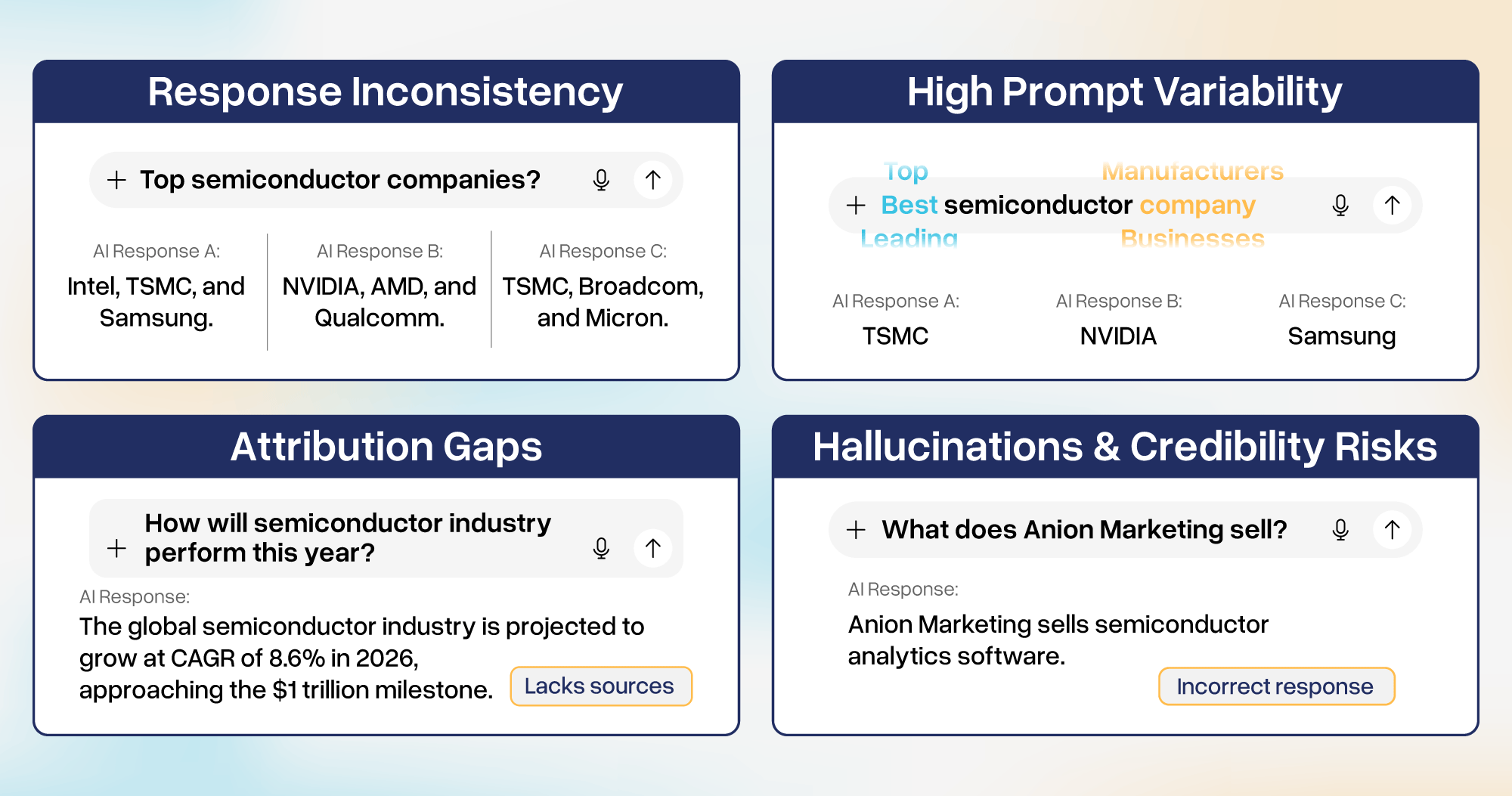
Response Inconsistency:
Hallucinations and Credibility Risks:
While traditional search engines might link to pages with errors, they won’t invent a feature your product doesn’t have. Instead of just fetching a correct fact, LLMs are optimized to generate plausible, intent-aligned answers that please the user.
A common risk is that AI can provide a "confident wrong answer" using confidence as a proxy for truth, often leading to credibility risk for your business.
Which Metrics Should Be Tracked for AIO/GEO?
If you are looking for a list of KPIs to include in your GEO Dashboard, you are in the right place. In the old days, we had a handful of north star metrics: “Impressions, Clicks, CTR...”, but in the AI Era, the dashboard can end up looking like a fighter jet cockpit.
Here is your new GEO Metric glossary:
Our Recommendation: Which 4 Metrics to Pick for Navigating GEO?
Measuring GEO can be like driving a car in a fog, especially when you have so many metrics to track. Let’s strip back all the noise and pick the top 4 metrics that would help you answer the most important questions regarding your AI strategy.
- AI Signal Rate: In the AI era, the measure of success has shifted from traffic to visibility. While we can’t measure absolute visibility, we can sample it with topic-specific prompts, repeated regularly, to assess presence percentage.
- AI Accuracy Rate: This crucial metric helps track the credibility of your brand in AI responses.
- AI Share of Model: Benchmarking your results against your competitors is a crucial part of GEO Strategy.
- AI Influenced Conversion Rate: At the end of the day, we are optimizing revenue. This metric connects the dots between a user’s chat on an LLM site to a lead in CRM.
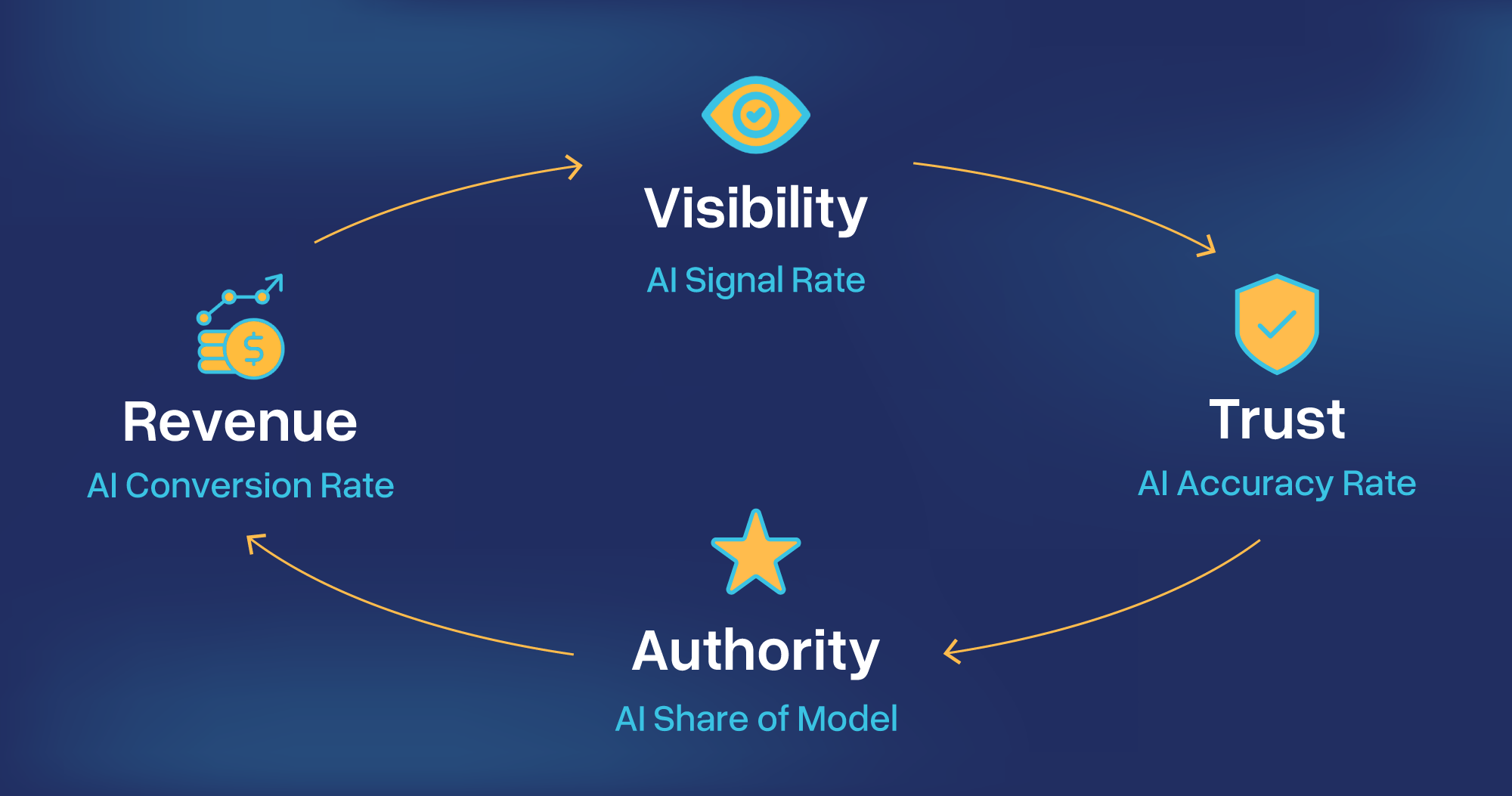
You can dive deeper into your own use case and figure out which metrics best suit your needs. These 4-core metrics, though, are holistic together and map the full funnel. The Signal Rate confirms your visibility, the Accuracy Rate ensures you are trusted, the Share of Model defines your market authority, and the Conversion Rate proves your strategy is working.
While understanding the metrics is the first step, building the right infrastructure to track them comes next. Tracking success in GEO requires a different set of tools than what we have used for decades.
AI is evolving rapidly, and at Anion Marketing, we don’t just monitor, we engineer your alignment with it. We help B2B semiconductor and tech companies develop GEO strategies, audit and architect technical content, and deploy the right stack of cutting-edge tools to track and convert AI responses to actionable insights.
Ready to upgrade your SEO to GEO? Contact Anion today!
About Author
Passionate about email marketing, automation, and turning data into campaigns that perform.